Scaling Lowcountry Boil for 50: The Math Behind Charleston's Favorite Party Dish | RecipePortions.com
I was standing in my 8x10 kitchen at 6 AM on a Saturday when my phone rang. It was my sister. She was hosting a graduation party for her daughter. Fifty people. She wanted to serve lowcountry boil. Shrimp. Corn. Potatoes. Sausage. She had a recipe that served eight. She asked me how to scale it. I asked her how big her pot was. She said, "Big." I asked her how many BTUs her burner put out. She said, "What?" I said, "This is going to be a long conversation."
Lowcountry boil is the perfect party food. It is messy. It is communal. It requires no plates if you are brave. And it scales beautifully — if you understand the math. If you do not understand the math, you end up with raw potatoes, overcooked shrimp, and a crowd of fifty hungry people staring at you like you just ruined their Saturday.
Here is the thing. Scaling a lowcountry boil is not linear. You cannot just multiply everything by 6.25 and call it a day. Because physics does not scale linearly. A pot that holds eight servings heats evenly. A pot that holds fifty servings has hot spots, cold spots, and a thermal mass that takes forever to come to a boil. The potatoes in the center might be tender while the ones on the edge are still crunchy. The shrimp on top might be perfect while the shrimp on the bottom turn to rubber.
The first rule of scaling lowcountry boil: do not use one pot. Use multiple pots. I told my sister to borrow three turkey fryers. Each one holds about ten gallons. That is enough for sixteen to eighteen servings per pot. Three pots equals forty-eight to fifty-four servings. Problem solved. Except now you have three pots to manage instead of one. Which means three timers. Three thermometers. Three people stirring. The math got simpler. The logistics got harder.
The second rule: stagger your ingredients. In a small pot, you throw everything in at once and it cooks in twelve minutes. In a massive pot, the potatoes need to go in first. Then the corn. Then the sausage. Then the shrimp. Each addition drops the water temperature. A small pot recovers in thirty seconds. A big pot takes three minutes. If you do not account for recovery time, your shrimp are in lukewarm water for five minutes. That is how shrimp get tough. That is how you disappoint fifty people.
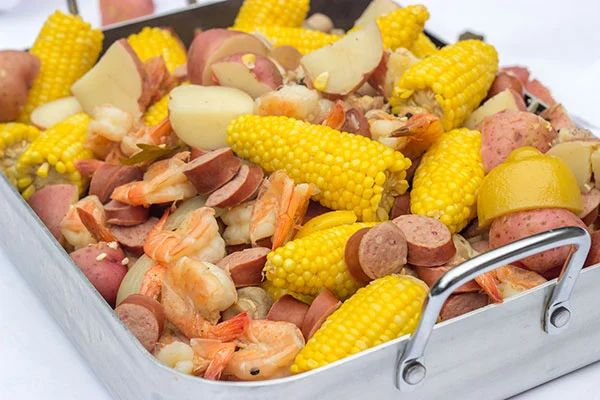
Here is the math I gave her. Per person: half pound of shrimp, one ear of corn, half pound of potatoes, quarter pound of sausage. For fifty people: twenty-five pounds of shrimp, fifty ears of corn, twenty-five pounds of potatoes, twelve and a half pounds of sausage. Plus seasoning. Old Bay does not scale linearly either. In a small pot, a quarter cup seasons everything. In three big pots, you need three-quarters cup per pot because the water volume is higher and the seasoning gets diluted. Total Old Bay: two and a quarter cups. She wrote it down. She underlined it twice.
The third rule: ice bath. In a small batch, you drain and serve immediately. In a big batch, the food at the bottom continues cooking in residual heat. You need an ice bath. Not for the food — for the pot. As soon as each pot is done, set it in a kiddie pool full of ice water. This stops the cooking instantly. It also makes you look like a lunatic in your backyard. But it works. The shrimp stay tender. The corn stays crisp. The potatoes do not turn to mush.
My sister called me at 3 PM. The party was over. She said it was perfect. Three pots. Three timers. One ice bath in a kiddie pool. Fifty happy people. She had leftovers for exactly one lunch the next day. That is the sign of good scaling. Not too much. Not too little. Just right. The math worked.
I love lowcountry boil because it is honest food. No pretense. No plating. Just dump it on a newspaper-covered table and let people eat with their hands. But honest food still requires honest math. If you are scaling for a crowd, do not guess. Do not eyeball. Do not trust your gut. Trust the numbers. The numbers do not lie. The numbers do not overcook shrimp. The numbers keep fifty people fed and happy.
If you are planning a party in Charleston — or anywhere — use the scaling calculator. Enter your base recipe. Enter your guest count. It will adjust the ingredients, tell you how many pots you need, and warn you about the timing. It is like having a culinary math teacher in your pocket. Which, technically, you do.
— Olivia Hartmann, Charleston
